
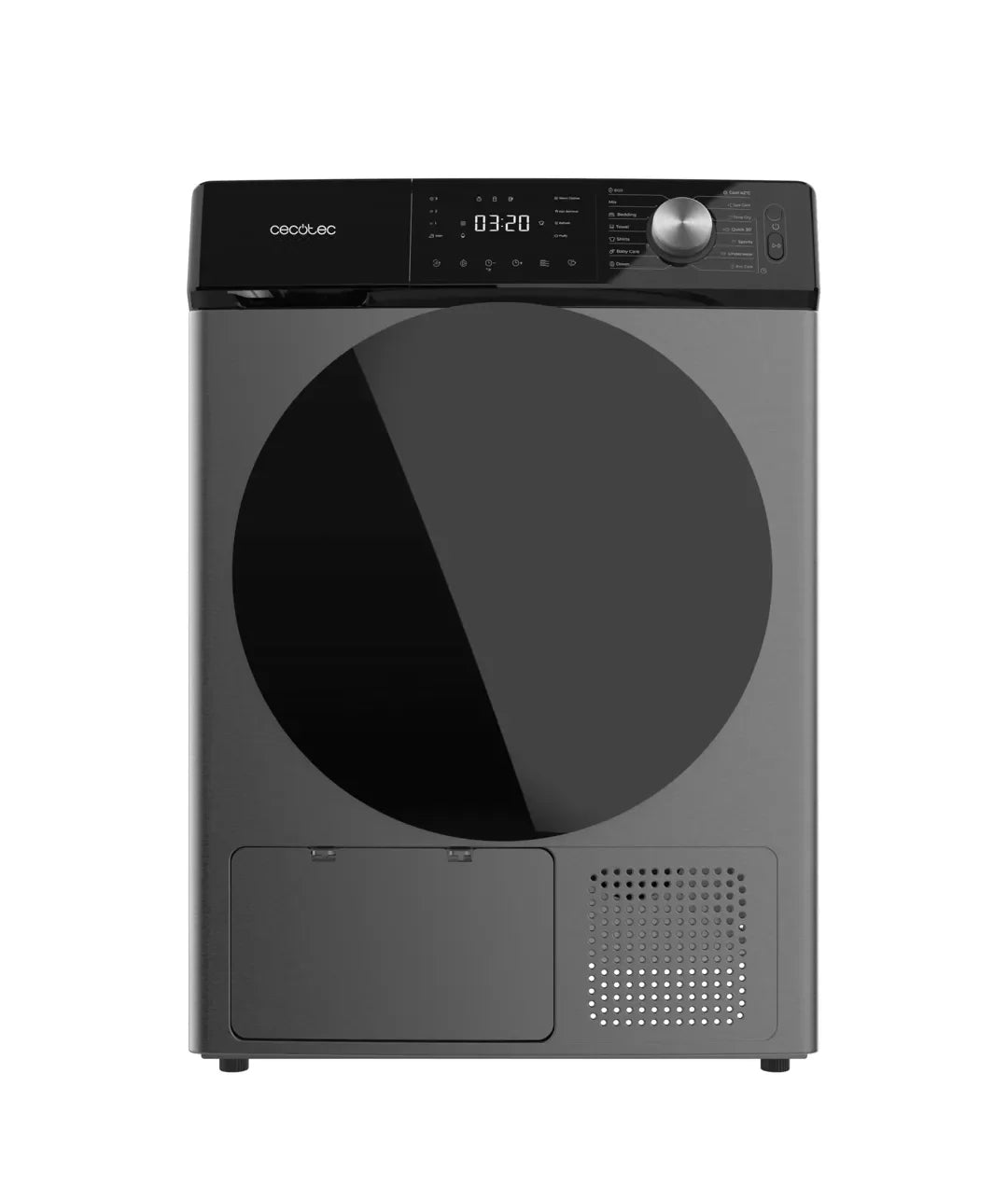
A heat pump dryer is a low-energy condensing model that reuses the air's heat in a closed circuit to dry clothes at a moderate temperature. Reaching energy classes A++ or A+++, it is the most efficient option on the market and does not need an external vent, although its purchase price is higher than that of a vented or classic condensing dryer.
Buying a dryer has become a decision of the head rather than the brand: the label is full of acronyms, there are three different technologies, and the difference in consumption between one and the other is truly noticeable on the bill at the end of the year. In this guide, we explain, with criteria and without unnecessary technicalities, the differences between vented, condensing, and heat pump dryers, how much they really cost, what capacity suits you, and how to get it right the first time. All the models and energy classes we cite are taken from the actual data sheets of the Merkimarket dryer catalog.
Key facts before choosing a dryer
- Three technologies: vented (expels the moist air outside), condensing (turns it into water in a tank), and heat pump (low-energy condensing with a closed circuit).
- The most efficient: the heat pump, with energy classes that usually range between A++ and A+++.
- No construction work: condensing and heat pump dryers do not need an external vent pipe; they can be placed in any ventilated room.
- Drying temperature: the heat pump works at a moderate temperature, which takes better care of delicate fabrics.
- Usual capacities: from 7 to 10 kg in the catalog, for households of one person up to large families.
- Warranty: legal minimum of three years for consumers in Spain, plus the seller's commercial warranty.
With this you already have the map; from here we develop each point so you can decide with confidence.
The three types of dryers: how each one works
All dryers do the same thing —spin the clothes inside a drum with hot air—, but the difference is in what they do with the moisture they extract. That detail conditions the consumption, where you can install it, and the price.
Vented dryer. It is the oldest and simplest technology. It heats the air, passes it through the clothes, and expels the moist air outside through a tube, just like an extractor hood. They are the cheapest to buy and the fastest, but also the ones that consume the most, and they require having an air outlet nearby, which greatly limits where to place them.
Condensing dryer. Instead of expelling the air, it cools it so that the moisture turns into water, which is collected in a removable tank (or drained through the drain). It does not need an exhaust pipe, so you can install it in any room. It consumes slightly less than the vented one and is the classic intermediate option.
Heat pump dryer. It is an evolution of the condensing one: instead of wasting the heat, it recycles it in a closed circuit using a heat pump, the same principle as an air conditioner. Reusing that heat boosts efficiency —hence the A++ and A+++ classes— and allows drying at a lower temperature, which extends the life of the clothes. It is the most expensive upfront, but the one that spends the least in the long run.

Heat pump dryer: why it has become dominant
If you look at the current catalog, you will see that the vast majority of recent models are heat pump, and it is no coincidence. The reason is purely economic: although you pay more when buying it, the savings on each drying cycle end up paying for it, especially if you use the dryer several times a week. For the same load, a heat pump dryer can consume around half the electricity of an equivalent vented one.
To those savings are added two practical advantages. The first is the care of the clothes: by working at a lower temperature, the garments suffer less shrinkage and wear, something that is appreciated in technical fabrics, wool, or delicate garments. The second is the freedom of installation: since it does not need an external vent, you can put it in a closet, an indoor laundry room, or next to the washing machine without construction work. The only toll is that they are slightly slower per cycle than a vented one, a small price in exchange for the savings.
In the catalog you will find references that illustrate this range well, such as the Bolero Dry 10350 Steel heat pump dryer, 10 kg, designed for large families, or the Bolero DressCode Dry 9400, 9 kg, with stainless steel drum, with a Full Touch panel and 15 programs.
Comparison: vented vs condensing vs heat pump
| Aspect | Vented | Condensing | Heat pump |
|---|---|---|---|
| Consumption | High | Medium | Very low (A++/A+++) |
| Purchase price | Lowest | Intermediate | Highest |
| Needs air outlet | Yes | No | No |
| Drying temperature | High | High | Moderate (takes care of clothes) |
| Speed per cycle | Fast | Medium | Slightly slower |
| Ideal for | Occasional use and low budget | Medium use without external vent | Frequent use and long-term savings |
Consumption and energy label: how much you really save
The energy label is your best ally for comparison. In dryers, the scale goes from D (least efficient) to A+++ (most efficient), and it is advisable to look not only at the letter, but at the annual consumption in kWh that appears on the label itself, calculated over a standard number of cycles. Between an A+++ and a lower class there can be a difference of several dozen euros a year depending on use.
The practical rule is simple: the more you use the dryer, the more profitable it is to pay for efficiency. For a household that dries two or three loads per week, an A++ or A+++ heat pump pays for itself easily compared to a cheaper vented one. If you are only going to use it sporadically in winter, the calculation changes and a more economical model may be worth it. If you want to delve deeper into how to read this data, our guide on the energy label and how much you really save will help you.

What dryer capacity to choose
Capacity is measured in kilos of dry clothes and is one of the data points that confuses people the most. It is advisable that the dryer has a capacity equal to or slightly higher than your washing machine, so you can dry what you wash in a load all at once. As a guide according to the catalog, which ranges from 7 to 10 kg:
- 7 kg: enough for one or two people, or a small apartment.
- 8 kg: the sweet spot for couples and families of three, the best-selling size.
- 9 kg: comfortable for families of four, with room for bedding.
- 10 kg: large families or those who dry duvets and towels frequently.
A common mistake is to oversize: a dryer that is too large for small loads is not more efficient, because it still runs the entire cycle. And another, to undersize: overfilling the drum lengthens the drying and wrinkles the clothes more. If you are between two sizes, think about the bedding, which is what takes up the most space.

How to choose your dryer in 5 steps
- Decide on the technology. If you are going to use it often, go for a heat pump for the savings; for occasional use and minimum outlay, consider vented or condensing.
- Look at the energy class. Look for A++ or A+++ and compare the annual consumption in kWh on the label, not just the letter.
- Adjust the capacity. Match or slightly exceed your washing machine load; 8 kg is the most balanced size for most.
- Check the space and installation. Measure the opening and depth; if you do not have an air outlet, rule out vented.
- Review programs and extras. Humidity sensors, anti-wrinkle programs, silent mode, or child lock make the difference in everyday use.
Ready to compare models? Explore the complete dryer catalog and, if you are still deciding on the rest of the laundry set, our guides on how to choose a washing machine and on when a top-loading washing machine pays off will be useful to you.
Frequently asked questions about dryers
Which dryer consumes less, the heat pump or the condensing one?
The heat pump one. By recycling the heat in a closed circuit, it reaches A++ or A+++ classes and can spend around half as much as a vented one and considerably less than a classic condensing one, that is why it is the most profitable if you use it frequently.
Does a heat pump dryer need an air outlet outside?
No. Both heat pump and condensing dryers turn moisture into water that is collected in a tank or goes to the drain, so you can install them in any ventilated room without construction work. Only vented ones require an exhaust pipe.
What dryer capacity do I need?
The ideal is to match or slightly exceed the capacity of your washing machine. For one or two people, 7-8 kg is enough; for families of four or more, or if you dry a lot of bedding, 9-10 kg is advisable.
Is it true that the heat pump takes better care of the clothes?
Yes. It works at a lower drying temperature than vented or traditional condensing, which reduces shrinkage and wear of the fabrics, especially in delicate garments.
Article written by the Merkimarket editorial team. Model data, capacities, and energy classes taken from the data sheets of the Merkimarket dryer catalog. Consumption and availability may vary; consult each data sheet for the information current in Spain.