
A compact toilet is a small-sized sanitary fixture —usually between 48 and 62 cm deep, compared to 65-70 cm for a standard model— designed for small bathrooms and powder rooms. It maintains usability ergonomics while freeing up walking space, and is available in floor-standing, wall-hung, and back-to-wall versions.
When the bathroom is small, every centimeter counts and the toilet is usually the piece that gets in the way the most. The good news is that you don't have to give up comfort to gain space: a compact toilet reduces the depth of the bowl without sacrificing seat height or flushing power. In this guide you will see what measurements define a compact toilet, what types exist, how to choose the right outlet, and which real models from the Merkimarket toilet catalog fit in a tight bathroom. All technical data is taken from actual product sheets in the store.
Key facts about compact toilets
- What they are: compact-depth toilets, designed for small bathrooms, guest toilets, and renovations where the walkway is narrow.
- Usual depth: between 48 and 62 cm, compared to 65-70 cm for a standard toilet.
- Types: floor-standing (with low tank), wall-hung (over a concealed frame), and back-to-wall.
- Common technology: rimless bowl (no inner rim) and dual flush, compatible with wall or floor drainage.
- Seat height: many models maintain comfort height (around 40-45 cm) despite the reduced depth.
- Material: glazed sanitary porcelain; seats in Supralit®, Duroplast, or thermosetting resin.
- Warranty: minimum legal three-year warranty for consumers in Spain, plus the seller's commercial warranty.
This gives you the summary; next we will develop each point so you can choose without making a mistake.
What exactly is a compact toilet
A compact toilet is not a "miniature" toilet: it is a model that reduces the depth of the bowl —the dimension from the wall to the front edge— while maintaining the width and usable height. Where a conventional toilet protrudes about 65-70 cm into the bathroom, a compact one stays around 48-62 cm. Those 10-15 cm less are very noticeable in a narrow powder room: they allow the door to open freely, to pass in front without brushing against it, and, in renovations, to gain space for a cabinet or a shower screen.
The important thing is that this reduction does not affect comfort: the seat maintains an ergonomic position and the tank maintains the necessary flush volume. That is why the compact toilet has become the standard solution for small bathrooms, under-stairs guest toilets, and second homes.
Types of compact toilet according to installation
The first criterion for choosing is not aesthetics, but how it is fixed to the bathroom. There are three main families:
Floor-standing with a low tank. It is the most common and the easiest to install: the bowl is anchored to the floor and the tank sits on top of it. It works in almost any bathroom and does not require wall work. In the compact version, the low-tank bowl reduces the depth while maintaining the dual flush, as in the Roca Dama compact Rimless low-tank bowl.
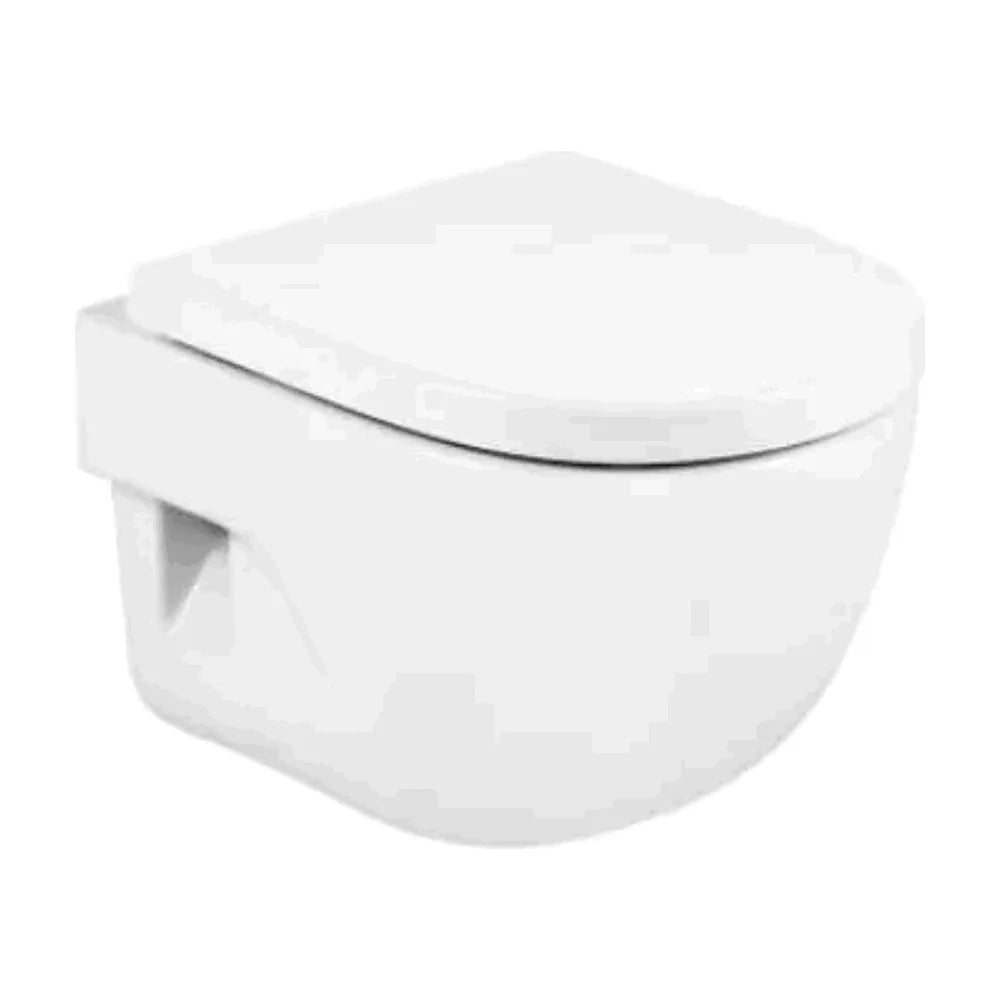
Wall-hung over a frame. The bowl hangs from the wall over a metal frame with a concealed tank. It is the visually cleanest option and the easiest to clean, because it leaves the floor clear; in return, it requires construction work to house the frame. In compact, it usually hovers around 48 cm deep, ideal for very tight powder rooms.
Back-to-wall. The bowl rests on the floor but stays flush against the wall, hiding the connections. It combines the aesthetics of the wall-hung with the simple installation of the floor-standing model. Brands like Aquore offer compact back-to-wall bowls with dual flush that fit almost any waste pipe.

Measurements: how big is a compact toilet
The measurement that really matters is the depth, because it is the one that takes away walking space. This comparison guides you on what you can expect:
| Dimension | Standard toilet | Compact toilet | Why it matters |
|---|---|---|---|
| Depth (length) | 65-70 cm | 48-62 cm | This is what gains walking space in the bathroom |
| Width | 35-38 cm | 35-37 cm | Hardly varies; maintains comfort |
| Bowl height | 40-45 cm | 40-45 cm | Maintains comfortable seat height |
| Distance from wall | Depending on outlet | Wall-hung ~0 cm | The wall-hung is the one that clears the most |
Before buying, measure the available space and subtract a safety margin for the lid and to be able to sit comfortably. If you want the complete method, our guide on toilet types, outlets, measurements, and how to choose yours will help you.
The outlet: the detail you cannot get wrong
It is useless to get the size right if the outlet does not match your drain. There are three types, and many compact models are sold as dual flush (they accept several):
- Horizontal outlet (to the wall): the drain comes out the back towards the wall. It is the most common in new construction and in wall-hung and back-to-wall toilets.
- Vertical outlet (to the floor): the drain goes straight down to the floor. Typical of older buildings.
- Dual flush: the toilet allows connecting to the wall or floor as needed, which greatly simplifies renovations.
If you are not sure about your outlet, choose a dual model: you will avoid surprises. Also, check if your bathroom has a visible or concealed tank, because it conditions both the frame and the construction work required.
Rimless and hygiene: why it is worth it in compact
Most current compact toilets are rimless, that is, without the inner rim where dirt and limescale traditionally accumulated. In a smaller bowl this is doubly useful: there is less surface, the water washes the entire wall of the toilet, and cleaning is faster. If you want to understand this technology well, we explain it in detail in the article about rimless toilets and why they are more hygienic. In small bathrooms, where everything is seen and gets dirty sooner, a compact rimless is almost always the best decision.

How to choose your compact toilet in 5 steps
- Measure the available depth. From the wall (or the frame) to where the edge can reach without blocking the walkway or the door. That number decides everything else.
- Confirm the outlet type. Look at your current drain: to the wall, to the floor, or unsure. When in doubt, choose dual flush.
- Decide the installation. Wall-hung if you are looking for maximum cleanliness and can do construction work; floor-standing or back-to-wall if you want a simple installation.
- Prioritize rimless and comfort height. More hygiene and a comfortable usage position even if the bowl is small.
- Close the matching lid. Choose a soft-close lid of the same model and material: it is the detail that is most noticeable in everyday life and the one most people forget.
Recommended compact models from the catalog
So you don't start from scratch, these are three real references that work well in small bathrooms, each of a different type:
- Wall-hung: the Roca Meridian compact wall-hung toilet, with horizontal outlet and optional lid, ideal for clearing the floor.
- Floor-standing: the Roca Dama compact Rimless low-tank bowl, easy to install and without construction work.
- Complete dual flush: the Roca The Gap Square dual flush toilet, one of the best sellers for its versatility to adapt to any drain.

You can see all available options in the Merkimarket toilet catalog, with shipping to all of Spain. And if you doubt between hanging it or leaving it on the floor, it will be good to review rimless toilets and their hygiene before deciding.
Frequently asked questions about compact toilets
How big is a compact toilet?
The depth of a compact toilet is usually between 48 and 62 cm, compared to 65-70 cm for a standard model. The width and seat height hardly change, so you gain walking space without losing usability comfort.
Is a compact toilet comfortable?
Yes. What is reduced is the depth of the bowl, not the height or seat width. Many compact models maintain comfort height (around 40-45 cm), so the feeling when sitting down is practically the same as a standard one.
What outlet do I need for a compact toilet?
It depends on your drain: horizontal if it goes to the wall, vertical if it goes down to the floor. If you are not sure or want flexibility, choose a dual flush model, which accepts both connections and simplifies the renovation.
Is a compact toilet cheaper?
Not necessarily: the price depends more on the type (wall-hung, floor-standing, or back-to-wall), the brand, and extras like the soft-close lid than the size. Check each sheet to see the current price and availability in Spain.
Article written by the Merkimarket editorial team. Technical data (measurements, types, outlets, and materials) are indicative and taken from the product sheets in the Merkimarket catalog. Exact measurements, prices, and availability may vary depending on the model; check each sheet for the current information in Spain.